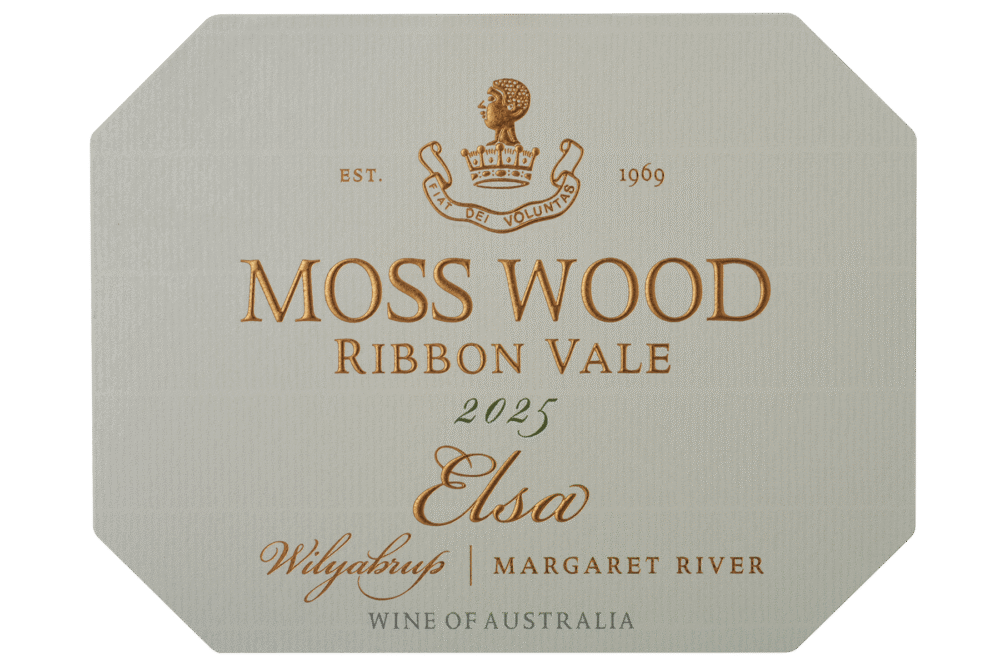
Moss Wood Ribbon Vale 2025 Elsa
| Wine Facts | |
|---|---|
| Median Harvest Date | 05/03/2025 |
| Harvest Ripeness | 13.3° Be |
| Yield | 7.75 t/ha |
| Day Elapsed between Flowering and Harvest | 101 days |
| Bottled | 12/01/2026 |
| Released | 27/03/2026 |
| Alcohol | 14.0% |
| Wine Facts | |
|---|---|
| Median Harvest Date | 05/03/2025 |
| Harvest Ripeness | 13.3 °Be |
| Yield | 7.75 t/ha |
| Day Elapsed between Flowering and Harvest | 101 days |
| Bottled | 12/01/2026 |
| Released | 30/03/2026 |
| Alcohol | 14.0% |
Moss Wood Ribbon Vale 2025 Elsa – Wine Pilot, Ken Gargett
Friends in the West tell me that the final outcome of the 2025 vintage in Margaret River may rival the legendary 2023. Even to be spoken of in those terms suggests that this is another exceptional year. This wine is very much Sauvignon Blanc dominant, 90%, with the remaining 10%…
Moss Wood Ribbon Vale 2024 Elsa – Jane Faulkner – James Halliday, The Wine Companion
A very classy wine that curtails overt flavour or heaviness with pitch-perfect aromas and flavours. Smoky, citrusy, a touch of spicy oak, a creamy and nutty texture, yet the acidity glides across the palate so lightly. It’s savoury and detailed with an excellent, very dry finish that lingers long. December,…
Moss Wood Ribbon Vale 2024 Elsa – James Suckling
An opulent Bordeaux-style white blend, giving notes of white peaches, nectarines, preserved lemons, cookies, apple blossoms and lanolin. The palate is textural and rounded with a creamy midweight feel, showing fresh ginger, quince, baking spices and a touch of fine oak. Drink or hold. Screw cap.
Moss Wood Ribbon Vale 2022 Elsa – James Suckling
This is a richly flavored, leesy chardonnay. Oatmeal, quince paste, bitter almond and nectarine. Mid-weighted and expansive. The lees handling is a bit overdone. The finish is peaty, blown out and oaky. Drink or hold.
Moss Wood Ribbon Vale 2024 Elsa – Huon Hooke, The Real Review
Bright light yellow colour; complex toasty, nutty bouquet, evidencing barrel fermentation, the palate following on with this theme with savoury dryness, super-intense flavour and a very dry, energetic and lingering finish. The oak is very well handled. A superb wine in the white Bordeaux style.
Moss Wood Ribbon Vale 2024 Elsa – The Wine Advocate, Erin Larkin
The 2024 Elsa leads with elderflower and lychee, lime zest and lavender soap. In the mouth, the wine is full of flavor and super intense—it feels quite exotic as compared to previous years, with a finish that moves toward waxy and floral. The season has soaked up the oak, which…
Moss Wood Ribbon Vale 2024 Elsa – Wine Pilot, Ken Gargett
The team at Moss Wood have said that the 2024 vintage reminds them of the great year of 1995. Yields were down but of high quality and everything augurs well for when we see the rest of this vintage released. During fermentation, the grapes were moved to 225-litre French oak…
Moss Wood Ribbon Vale 2024 Elsa – Wine Pilot, Cassandra Charlick
Pillowy and nougatine on the nose, with marzipan and vanilla bean laced apricot, custard apple, feijoa and pear skin. Tropical honeydew melon follows with a tint of lemongrass and baked hay. Plenty of fruit sweetness and buttery malolactic notes on the palate, which balances Sauvignon’s bright acidity nicely. Vanilla brioche,…
Moss Wood Ribbon Vale 2024 Elsa – Andrew Caillard, The Vintage Journal
Pale colour. Fresh grapefruit, lemon curd, tonic aromas with hints of marzipan/ grilled nuts. Well-concentrated with ample grapefruit, lemon pastille fruits, underlying tonic water notes, fine bittersweet textures and fresh indelible acidity. Refreshingly minerally at the finish. Drink now – 2032 14% alc
Moss Wood Ribbon Vale 2024 Elsa – Ken Gargett, The Wine Pilot
The team at Moss Wood have said that the 2024 vintage reminds them of the great year of 1995. Yields were down but of high quality and everything augurs well for when we see the rest of this vintage released. During fermentation, the grapes were moved to 225-litre French oak…
VINTAGE NOTES
2025 Ribbon Vale Vintage
The 2024/25 growing season at Ribbon Vale progressed steadily and without major disruption, allowing both Chardonnay and Sauvignon Blanc to ripen in a measured and unforced manner. Calendar year rainfall in 2024 totalled 910mm, below the long-term average of 1012mm, but sufficient to establish adequate soil moisture reserves in this dry-grown vineyard.
Spring conditions were ideal. During flowering, Chardonnay received 14.4mm of rainfall and Sauvignon Blanc 9.4mm. While rainfall at this stage of the season can influence crop levels, these modest falls occurred under otherwise favourable conditions and had no negative impact on fruit set. Final yields reflected this, with Chardonnay cropping at 6.37 tonnes per hectare and Elsa at 7.75 tonnes per hectare.
As the season moved into summer, temperatures remained moderate, with no prolonged heat events. The growing season average temperature for Elsa was 20.42°C, effectively identical to the long-term average of 20.43°C, while Chardonnay recorded a slightly cooler-than-average growing season at 20.07°C compared with its long-term average of 20.36°C.
From the beginning of January through to harvest, 22.8mm of rain was recorded. This modest rainfall ensured the vines were not subject to water stress during the latter part of ripening, while remaining low enough to avoid dilution. Ripening progressed evenly, with Elsa completing its cycle in 101 days from flowering to harvest, closely aligned with its long-term average of 100 days. Ribbon Vale Chardonnay recorded 120 days from flowering to harvest, consistent with its long-term average.
Harvest timing differed slightly between the two wines. Elsa was harvested seven days later than its long-term average, reflecting the even pace of ripening, while Ribbon Vale Chardonnay was harvested two days earlier than average, consistent with timely flavour development.
Taken together, the season was defined by consistency rather than extremes. Favourable spring conditions established solid yields, followed by a mild summer that allowed for steady, uninterrupted ripening. Rainfall was sufficient to support vine function without compromising concentration, and harvest timings were closely aligned with long-term averages. The wines show good balance and structure, in line with what we would expect from these conditions.
PRODUCTION NOTES
The Elsa is a blend of Sauvignon Blanc (90%) and Semillon (10%), with fruit sourced from the Ribbon Vale vineyard. All fruit was hand-picked, sorted and whole-bunch pressed, followed by juice clarification by flotation and inoculation with multiple yeast strains for primary fermentation in stainless steel tanks.
At the midpoint of fermentation, the wine was transferred to French oak barriques, 11% of which were new, to complete alcoholic fermentation and undergo malolactic fermentation. Oak usage was deliberately restrained to support texture and integration rather than dominate the wine. The wine matured in oak for approximately nine months before being blended in stainless steel. Fining trials showed no improvement to tannin balance, and the wine was fined with bentonite for protein stability, cold stabilised, sterile filtered and bottled on 12 January 2026.
Tasting Notes
Colour and condition:
Clear and bright condition; pale straw hue.
Nose:
Citrus and floral aromatics are most evident, with notes of lemon rind, white stone fruit and subtle savoury complexity.
Palate:
Medium to full bodied with good fruit depth and texture. Fresh acidity provides lift and definition, while fine phenolics contribute structure and length. The finish is clean, balanced and persistent.
Cellaring:
The 2025 Elsa has the structure and balance required for extended cellaring. While enjoyable on release, we recommend a minimum of 10 years in bottle to allow the development of additional complexity and secondary characters.