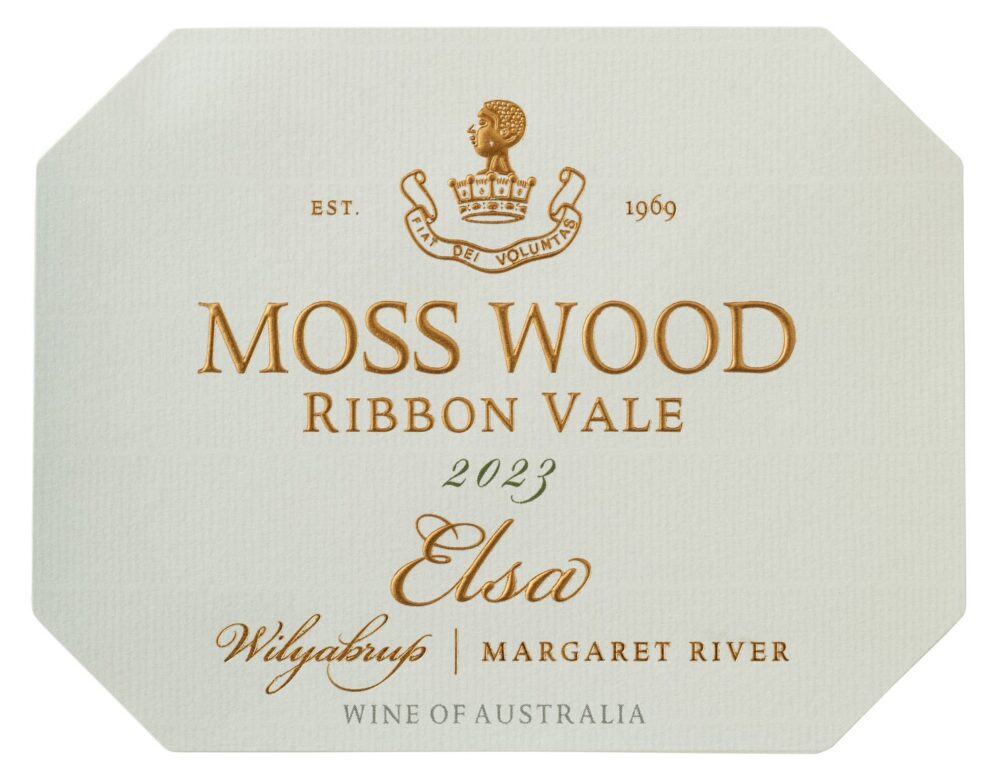
Moss Wood Ribbon Vale 2023 Elsa
| Wine Facts | |
|---|---|
| Median Harvest Date | 14/03/2023 |
| Harvest Ripeness | 13.3 °Be |
| Yield | 10.8 t/ha |
| Day Elapsed between Flowering and Harvest | 102 days |
| Bottled | 18/01/2024 |
| Released | 08/03/2024 |
| Alcohol | 14.0% |
| Wine Facts | |
|---|---|
| Median Harvest Date | 14/03/2023 |
| Harvest Ripeness | 13.3 °Be |
| Yield | 10.8 t/ha |
| Day Elapsed between Flowering and Harvest | 102 days |
| Bottled | 18/01/2024 |
| Released | 08/03/2024 |
| Alcohol | 14.0% |
Moss Wood Ribbon Vale 2023 Elsa – Erin Larkin, The Wine Advocate
The 2023 Elsa leads with a supremely elegant nose of white peach and white chocolate, a hint of sandalwood and scraped vanilla pod, dried coriander and poached green apples. In the mouth, the wine is opulent and very ripe, with custard powder and caramel, nashi pears and lemon drops. The…
Moss Wood Ribbon Vale 2023 Elsa – Cassandra Charlick-Camerer, Wine Pilot
Full malolactic fermentation, 7% new oak for nine months. Very inviting on the nose thanks to crème brulee creaminess, artisan candied fruit, vanilla bean and slight honeysuckle musk. The perfumed oak is in abundance, with a delicate toast, charry fringes and plenty of prettiness. Following on, the palate is unctuous…
Moss Wood Ribbon Vale 2023 Elsa – Jane Faulkner – James Halliday, The Wine Companion
Sauvignon blanc. On song with its flavours and texture; it’s really a classy wine. A beautiful balance of white stone fruit, citrus and gooseberries with a smidge of feijoa. The textural palate steals the show with its creamed honey lees and subtle oak with a slight phenolic tug adding extra…
Moss Wood Ribbon Vale 2023 Elsa – Sam Kim, Wine Orbit
Complex and engaging, the bouquet shows ripe peach, lemon peel, nougat and subtle pastry aromas, leading to a splendidly weighted palate offering saline texture combined with bright acidity. Superbly structured with alluring flavours, finishing wonderfully long and vibrant. A blend of 94% Sauvignon Blanc & 6% Semillon. At its best:…
Moss Wood Ribbon Vale 2023 Elsa – Ken Gargett, Wine Pilot
This is a wine which takes us into a different realm of Sauvignon Blanc, with whole bunch pressing, fermentation in stainless steel tanks before transfer to oak. 225 litre French oak barriques, 7% new, with nine months maturation. The nose offers florals and seabreeze notes, a real oystershell character to…
Moss Wood Ribbon Vale 2023 Elsa – Fergal Gleeson, Great Wine Blog
The plan was to revamp how they made Sauvignon Blanc. They had an eye on the great whites of the Loire Valley as a template. Well 2023 Elsa is their best yet. Handpicked and sorted, the grapes get the luxury treatment in the vineyard and winery. Elsa ’23 is disciplined…
Moss Wood Ribbon Vale 2023 Elsa – Angus Hughson, Vinous.com
The finely tuned 2023 White Blend Elsa Ribbon Vale is generously proportioned and youthful as it radiates grapefruit and lemon pith with a touch of exotic green mango and green herbs, all well integrated with French oak. Expressive and creamy textured oak flavors add backbone to what is a sophisticated…
Moss Wood Ribbon Vale 2023 Elsa – Marc Malouf, Wine Worth Writing About
Light straw with a cyan hue and a nose that will make any Savvy B lover grin with pleasure. Aromas of delicate white florals, complex and zesty sherbet-like citrus, orange blossom water, green apple, mangosteen, honeydew and sweet snow peas, spiced with gingerbread, nougat and vanilla-rich oak. In the mouth…
Moss Wood Ribbon Vale 2023 Elsa – Gary Walsh, The Wine Front
The cold never bothered me anyway. Here’s an interesting wine, and a different expression of Sauvignon compared with your usual Margaret River styles. It’s all lime and lemon curd, honey and florals, fennel fronds, and gingersnap biscuits. It’s soft and creamy, a suggestion of butterscotch pudding and banana, but with…
Moss Wood Ribbon Vale 2023 Elsa – Ray Jordan, Ray Jordan Wine
This intriguing interpretation of a sauvignon blanc dominant wine was introduced just a few years ago. I have loved it from the start. Has about 10 per cent semillon in it, but it is the savvy which really dominates. There are the usual tropical, guava and slightly passionfruit lemony characters…
VINTAGE NOTES
2023 Ribbon Vale Vintage
The 2022-23 growing season was a very good one, potentially great! The vines enjoyed a solid winter of rainfall with 1114mm falling for the calendar year 2022, 9% above average. This level is optimal for our unirrigated vines as their deep root systems are able to access this soil moisture throughout the summer and avoid stress as the grapes begin to ripen.
We’re a bit fussy about when we want the rain to fall… lots through the winter, but once the vines begin flowering, we like the weather to turn mild and dry. Chardonnay, in particular, is extremely susceptible to inclement conditions which can result in below average yields. Readers can draw their own conclusions as to whether we’re asking for too much of mother nature. Fortunately, she looked after us in late 2022, with just 23mm falling during the Chardonnay flowering period and 8.6mm falling on the Sauvignon Blanc. All in all, conditions were fantastic and we were hopeful of solid crops.
We didn’t have it all our own way, however, as after the 9th of December, the tap pretty much turned off, with no rain recorded again until the 15th of March. Once again, if we’re being picky, we like to see some rain falling during December and January as these little top ups can help sustain the vines. Nevertheless, the drought wasn’t a problem and this became clear when we harvested. Both Chardonnay and Sauvignon Blanc produced good yields. Chardonnay came in at 5.72 tonnes/hectare, 19% above average, and Sauvignon Blanc registering 10.8 tonnes/hectare, 1% above average.
Temperatures were ideal, with Chardonnay recording an average growing season temperature of 19.96°C and Sauvignon Blanc 20.21°C. For context this puts 2022/23 as slightly cooler than 21/22 (21.01°C) and slightly warmer than 20/21 (19.43°C). These differences may seem small, but they’re responsible for perceivable stylistic variations in the wines.
Ultimately, the season unfolded smoothly, characterised by warm, rain-free days. The vineyard was free of disease and the fruit was in immaculate condition. Sauvignon Blanc was picked on the 14th March, about 2 weeks later than average, and Chardonnay coming off on the 24th March, 2 days later than average.
PRODUCTION NOTES
The inspiration for the Elsa production techniques continues to be the wines of the Loire Valley in France, specifically the localities of Sancerre and Pouilly-Fume. In both regions the emphasis is on complex Sauvignon Blanc and methods employed are similar to Burgundy. In its freshest form, Sauvignon Blanc produces ethereal, grassy wines typified by the Marlborough region in New Zealand. Although these wines have their place, our preference is for the more complex aromatics and texture and weight seen in the Loire.
The Sauvignon Blanc was picked by hand and transported to the winery, where the grapes were hand-sorted and pressed as whole bunches, followed by juice clarification and inoculation with multiple yeast strains for primary fermentation in stainless steel tanks. Alcoholic fermentation was maintained at a controlled temperature of up to 20°C. At the midway point, as activity slowed, the fermenting must was transferred to oak.
For the 2023 Ribbon Vale Elsa, barrels were 225-litre French oak barriques, with 7% being new. We aim for an integrated oak presence, harmoniously complementing both the aroma and palate.
Following full malolactic fermentation, each batch was blended, treated with sulfur dioxide, and returned to barrel. Oak aging continued until January 3rd, 2024, totaling 9 months, before the wine was blended in stainless steel. Although fining trials were conducted to optimise tannin balance, no treatments proved beneficial. Subsequently, the wine underwent bentonite fining for protein stability, cold stabilisation, sterile filtration, and was bottled on January 18th, 2024.
Tasting Notes
Colour and condition:
Clear and bright condition, pale straw colour.
Nose:
The nose is bright, lifted and displays characters of jasmine, ginger, loquats, lemon rind, lemon/lime curd and citrus cheesecake, hint of biscuit, honey and nougat in the background. Toasty and vanillan oak in the background.
Palate:
The palate has good weight and fruit depth with lingering flavours of white peach, nashi pear, honeydew melon and grapefruit. Generous mouthfeel and balanced acidity underpin rich characters of crème brulee and bread and butter pudding. There is some tannin on the finish giving the backbone required for good cellaring.
Cellaring:
The Elsa has the fruit depth and composition to age well and we recommend at least 10 years to ensure the development of a classic Sauvignon Blanc bottle bouquet of buttered toast and lanolin. In the meantime, the wine can be enjoyed for its attractive youthful freshness.