
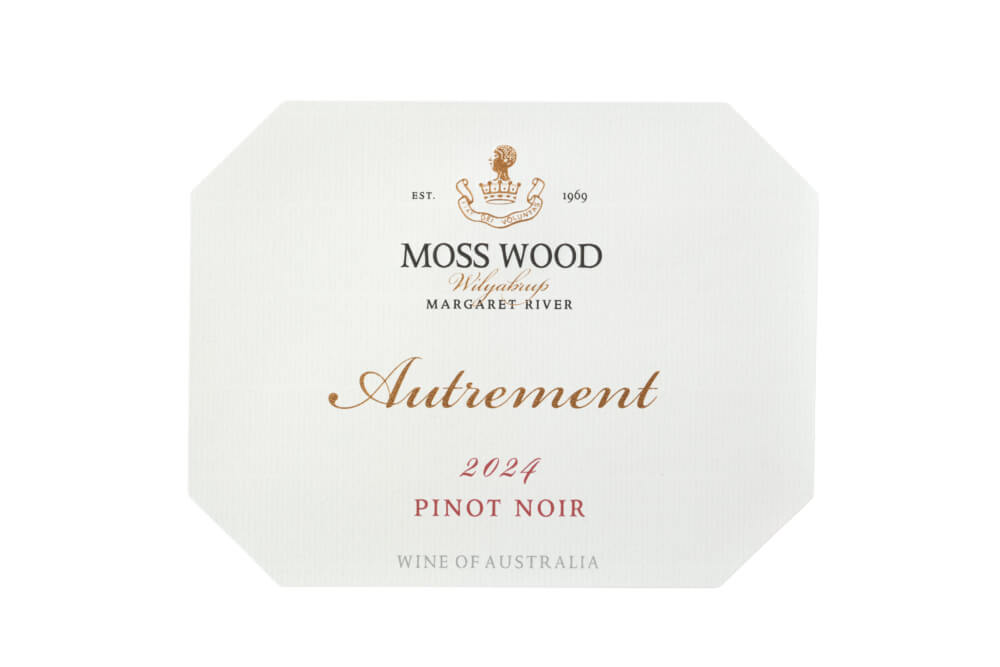
| Wine Facts | |
|---|---|
| Median Harvest Date | 2nd February, 2024 |
| Mean Harvest Ripeness | 13.4° Be |
| Bottled | 1st July, 2025 |
| Released | 1st August, 2025 |
| Alcohol | 13.7 % |
Moss Wood 2024 Autrement Pinot Noir – Sam Kim, Wine Orbit
Sweetly fruited with savoury nuances, the fragrant bouquet shows dark plum, cured meat, warm mushroom, baking spice, and toasted almond characters, followed by a silky-smooth palate that’s succulent and beautifully weighted. It’s wonderfully structured with refreshing acidity and grainy tannins, finishing lingering and delectable. At its best: 2028 to 2036….
Moss Wood 2024 Autrement Pinot Noir – Melissa Moore, The Real Review
Bright crimson, with inviting aromas of red cherry pie and dusty forest roads. There’s a ripe sweetness on the palate with a line of tangy acidity as backbone, all wrapped in a frame of velvety tannins that grip until the end. Drinks well now and will hold for a few…
Moss Wood 2024 Autrement Pinot Noir – Angus Hughson, The Vintage Journal
The name, we are told, means “in another way”, in French, which the team see as reflective of their Pinot Noir journey. Many have questioned why they persist with this variety when the region seems, if not better suited to other grapes, then more successful with them. Perhaps, quite simply,…
Moss Wood 2024 Autrement Pinot Noir – Edward Agg, The Cellar Post
Darker, fleshier, and more fruit forward than the flagship Pinot Noir by Moss Wood. Cherries, cherry stones, plum, wild strawberries, hints of citrus peel and black tea, perhaps a touch of pepper on the nose. Medium-bodied and concentrated on the palate, those darker fruit qualities transition through from the nose…
Moss Wood 2024 Autrement Pinot Noir – Ray Jordan, Wine Pilot
The name “Autrement,” meaning “in another way” in French, reflects Moss Wood’s journey in Pinot Noir discovery. This wine is crafted from fruit sourced in the southern Karridale region, 60 kilometers south of Moss Wood’s Wilyabrup base. Moss Wood has a history of exploring pinot noir from different regions, including…
Moss Wood 2024 Autrement Pinot Noir – Fergal Gleeson, Great Wine Blog
There’s a new and delicious addition to the Moss Wood range – Autrement Pinot Noir 2024 Veteran Winemaker Keith Mugford has sourced grapes from Margaret River’s cool southern district Karridale, a full 60 kms south of Moss Wood’s Wilyabrup home. The result? A refreshing and lively Pinot With red and…
Moss Wood 2024 Autrement Pinot Noir – Marc Malouf, Wine Worth Writing About
Moody ruby with a charming nose of cherry blossom, fig leaf, cinnamon, strawberry leaning red berries, watermelon, beetroot powder, blood orange, a touch of fern, white pepper and sweet, freshly turned soil. Classical! In the mouth it’s medium bodied, but full of flavour and blooms with a core of sweet…
Moss Wood 2024 Autrement Pinot Noir – Erin Larkin, The Wine Advocate
The 2024 Autrement Pinot Noir features fruit grown in Karridale, in Margaret River’s cooler, wetter south. The area is impacted by the cold, wild winds off the Southern Ocean (next stop, Antarctica) and produces fruit that is distinctly different in style from the rest of the region—”autrement” is the French…
ORIGIN
“Autrement” is the French word for “in another way” — we think a fitting name reflecting our enjoyment and exploration of Pinot Noir in its many different iterations, on its travels from its cultural and undisputed home of Burgundy. We are thrilled to have made this wine from a selected parcel of grapes from a well established vineyard in Karridale, Western Australia.
Pinot Noir has long fascinated us at Moss Wood. First planted at Moss Wood in 1973, with the inaugural 1977 vintage released in 1979. This makes it one of the oldest Pinot Noir vineyards in Western Australia and the country. The interest began with Sandra and Bill Pannell, who had the foresight to plant it and has been a heartfelt love affair carried forward by Clare and Keith Mugford after they acquired management of Moss Wood in 1984 and then ownership in 1985. Today, the fascination continues with the next generation, as Hugh and Tristan Mugford pursue its ongoing development.
Pinot Noir is one of the most compelling varieties to grow and make. It responds acutely to both viticultural conditions and winemaking inputs, meaning the character of Pinot grown at Moss Wood in Wilyabrup is vastly different to that grown even a few kilometres away.
While Moss Wood Pinot Noir has been released every year since 1977, we’ve occasionally explored the variety in other regions. Between 1991 and 2003, we produced a Pemberton Pinot Noir, and from 2008 to 2010, we made wine from the Mornington Peninsula. Both were rewarding projects that broadened our understanding of the variety, but ultimately proved difficult to manage during the busy harvest period at home.
Fast forward to late 2023, when Hugh Mugford caught wind of high-quality Pinot Noir fruit available in Karridale, 60 kilometres south of Moss Wood. Further investigation revealed the vineyard contained three different clones and, once again, the spark was lit. A phone call to Clare and Keith followed, and after a vineyard visit and fruit tasting, we found exciting potential - particularly in the way the flavour profile clearly differed from our Wilyabrup fruit.
So, the decision was made. We were going to make a Pinot Noir from Karridale.
Vineyard
While both Wilyabrup and Karridale fall within the Margaret River GI, the climatic and phenological differences between Moss Wood and the Karridale site are significant, and these have a notable impact on vine behaviour, ripening patterns, and ultimately, wine style.
Moss Wood is located approximately 60 km north of Karridale and receives greater seasonal heat accumulation - typically around 1600-1700 Growing Degree Days (base 10°C), compared to 1300-1400 GDD in Karridale. This translates to a more rapid progression through key phenological stages: budburst, flowering, veraison and harvest all occur earlier. Pinot Noir at Moss Wood is usually picked in mid to late February, while in Karridale, harvest generally takes place in early to mid-March, generally about two weeks later.
Wilyabrup has a maritime climate but being more northerly, experiences warmer daytime temperatures and broader diurnal range, compared with Karridale. The latter, by contrast, is strongly influenced by its proximity to the Southern Ocean, where cooler daytime highs, higher humidity, and smaller diurnal shifts slow ripening and favour the preservation of natural acidity and the development of fine tannins and phenolics.
Clonal diversity is another key point of difference. The Karridale vineyard is home to three Pinot Noir clones, each contributing distinct characters:
- D4V2 – Often called the “droopy” clone due to its growth habit. Also planted at Moss Wood, it typically contributes bright aromatics and red fruits, particularly strawberry and cherry. This clone was imported from the University of California at Davis.
- 2325 (H7V15) – An Australian clone developed by the CSIRO, known for its firm tannin structure and savoury character. It brings backbone to the wine.
- D2V6 (also known as 2222) – Another Davis-origin clone introduced via Australia’s early clonal programs. It tends to offer deeper colour and a darker fruit profile, including blackcurrant and plum.
Lastly, the Karridale vineyard is trained on the Geneva Double Curtain (GDC) trellis system. As with the Scott Henry system used at Moss Wood, this approach significantly improves sunlight exposure to the fruit zone and promotes even ripening - both essential for achieving full flavour development in a cool-climate site.
Vintage Notes
The 2023–24 growing season was shaped by warm and dry conditions, bringing forward ripening across all varieties - reminiscent of vintages like 1995 and 2007. With maturity reached around 2–3 weeks earlier than average, we harvested all Pinot Noir clones on 2nd February.
Fruit was hand-picked and trucked to Moss Wood, where it was meticulously hand sorted. To build savoury complexity, 30% of the fruit was fermented as whole bunches, with the remaining 70% destemmed. The must was chilled to 8°C and held for 48 hours for cold soaking - to extract colour, flavour, and tannin.
After the cold soak, the must was allowed to warm and fermentation began spontaneously with wild yeast. This approach was taken with the aim of enhancing aromatic expression and mouthfeel. Once fermentation had reached approximately 3-4% alcohol, we seeded the tanks with cultured Saccharomyces cerevisiae yeast to ensure a reliable fermentation to dryness. Hand plunging was done three times daily, and fermentation temperatures were held to a maximum of 32°C.
After 16 days on skins, each batch was pressed individually and completed primary and malolactic fermentation in tank. Wines were adjusted and transferred to barrel (18% new oak) for 15 months’ maturation. In October 2024, they were racked, analysed, and returned to barrel. Final racking and blending took place in June 2025. Fining trials were conducted, but none improved balance, so the wine remained unfined. It was sterile filtered and bottled on 1st June 2025.
TASTING NOTES
Colour and condition :
Vibrant crimson red; clear and bright condition.
Nose :
A lifted and expressive nose showing primary aromas of red fruits - strawberry, raspberry and red cherry - supported by floral notes of rose petal and potpourri. Beneath the fruit lies subtle complexity, with background hints of cedar, mushroom and forest floor. Gentle spice notes of clove and charred oak round out the nose.
Palate:
The palate is driven by vibrant red fruit flavours - strawberry, cherry and redcurrant - that give the wine a lively and generous presence through the front and mid-palate. There is impressive red fruit density, offering concentration without being sappy or heavy. These characters are layered with savoury notes of dried herbs, mushroom and a hint of forest floor, providing subtle complexity. The texture is supple and velvety, with fine tannins and bright acidity sitting neatly in the background, carrying the wine through to a long, elegant finish.
Cellaring
As is typical of Pinot Noir, the 2024 Autrement shows immediate charm - with generous fruit depth and balance making it very attractive in its youth. However, this early drinkability doesn’t compromise its cellaring potential. Thanks to low yields and the concentration they bring, we see strong prospects for ageing.
The wine offers vivid Pinot expression now, but its composition suggests it will evolve beautifully. We expect further bottle development over the next five years and potential to move toward more savoury and complex characters with time. Between seven and ten years of age, those who appreciate Pinot Noir’s earthy, mushroom bouquet layered with bright fruit will be well rewarded.