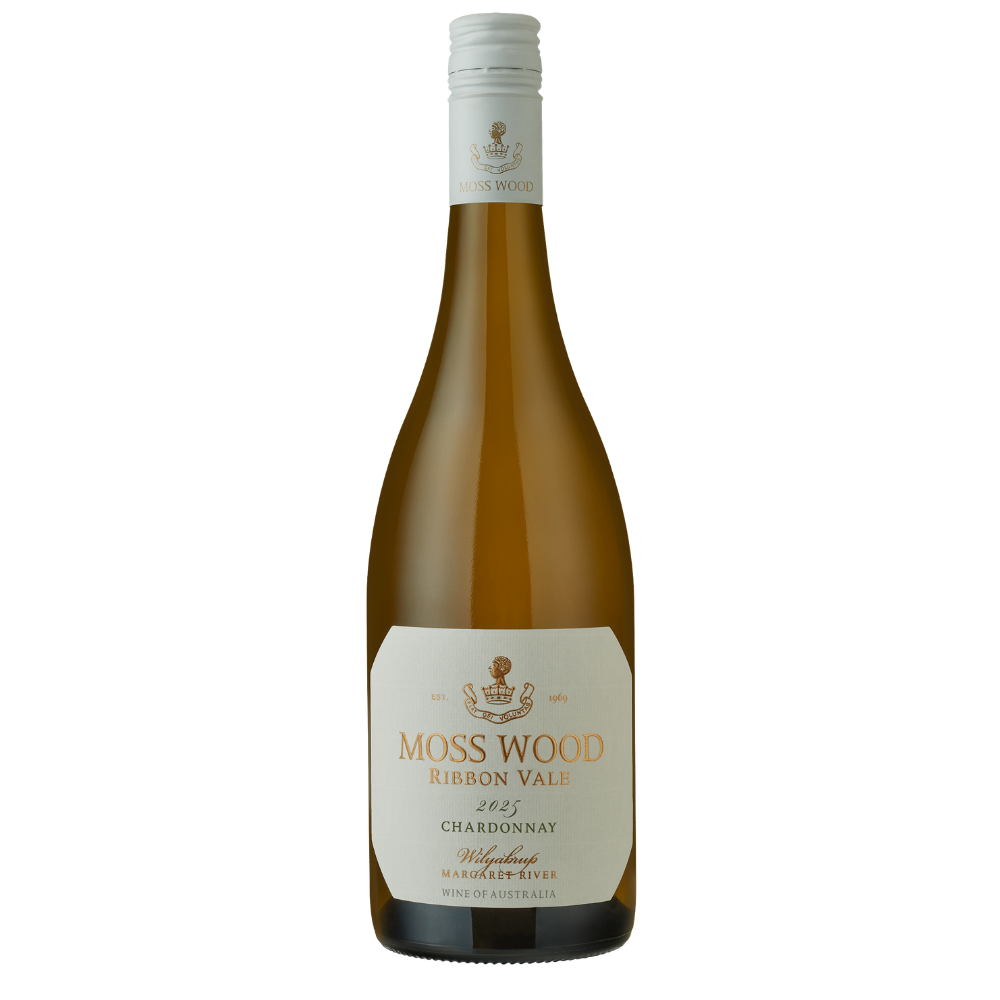
Moss Wood Ribbon Vale 2025 Chardonnay
| Wine Facts | |
|---|---|
| Median Harvest Date | 11/03/2025 |
| Harvest Ripeness | 13.2 °Be |
| Yield | 6.37 t/ha |
| Day Elapsed between Flowering and Harvest | 120 days |
| Bottled | 12/01/2026 |
| Released | 27/03/2026 |
| Alcohol | 14.0% |
Wine Facts
-
Median Harvest Date
11/03/2025
-
Mean Harvest Ripeness
13.2 ⁰ Be
-
Yield
6.37 t/ha
-
Day Elapsed between Flowering and Harvest
120 days
-
Bottled
12/01/2026
-
Released
30/03/2026
-
Alcohol
14.0%
Moss Wood 2023 Cabernet Sauvignon – Cassandra Charlick, Decanter
An early-morning brightness of purple fruit, mulberry, plum, salted cassis and hints of aniseed, crushed minerality, quartz and graphite. It’s very inviting, with inky black olive brine and nori. The palate is packed with concentration, complexity, succulence, spice and power. Cassis and almost tar-like notes, acidity with jewel-like clarity singing…
Moss Wood 2023 Cabernet Sauvignon – Campbell Mattinson
This is luscious and lovely and loaded with pure, concentrated blackcurrant flavour and yet, crucially, it’s also balanced, fresh, lengthy and ultimately elegant. It’s everything that a great Margaret River cabernet should be. It adds complementary tobacco notes to the swoosh of fruit; there are whispers of bay leaf; creamy…
Moss Wood Ribbon Vale 2025 Elsa – Campbell Mattinson, The Wine Front
A flash of bubble-gum to the aromatics and a raw cedar character to the palate, which lets you know for certain that it was oak-matured or at least partially so. It’s a dry, thistle-and-burr style with gravel, woodsmoke, lemon peel and waxy/lanolin characters teaming throughout. Length is excellent, and brings…
Moss Wood Ribbon Vale 2025 Chardonnay – Campbell Mattinson, The Wine Front
Serious chardonnay. Refined and taut but, at the same time, there’s no mucking around here. Peaches grilled, lemon curd, pears, toast, brine, steel and roasted-and-salted cashews. There’s no flint, no flare, no room for more. This is Margaret River chardonnay served bold, neat and immaculate. Drink: 2027 – 2032+ August,…
Moss Wood 2025 Amy’s Cuvee Blanc – Jane Faulkner – James Halliday, The Wine Companion
Mostly semillon with a glug of sauvignon blanc, and in the glass it’s a light straw gold. Flavourful with toasty oak, nutty lees and plenty of zippy acidity. It’s refreshing, yet there’s definition across the palate, so it feels rich and ripe with a tug of phenolics on the otherwise…
Moss Wood 2024 Semillon – Jane Faulkner – James Halliday, The Wine Companion
A warm, riper vintage; this an expression of the season – rightly so. Plenty of acidity nonetheless corrals melon, stone fruit, citrus and creamy lees flavours. It’s a little smoky, with more richness and texture than usual. August, 2024
Moss Wood 2022 Cabernet Sauvignon – Jane Faulkner – James Halliday, The Wine Companion
When you’re the flagship, there’s always pressure because you must be the best of the best. Well, take a bow. This harnesses all the power of fruit and winemaking, all seemingly effortlessly, and turns it into an elegant, stunning wine balancing savouriness with fruit. Just the right amount of cassis,…
Moss Wood Ribbon Vale 2022 Merlot – Jane Faulkner – James Halliday, The Wine Companion
Merlot with decent glugs of cabernet franc and cabernet sauvignon; aged 26 months in French oak barriques, 21% new. It comes across as detailed, structured and fuller bodied but not weighty. While its core is all dark fruits with baking spices and licorice, it’s savoury with tobacco, peat and roasted…
Moss Wood 2023 Pinot Noir – Jane Faulkner – James Halliday, The Wine Companion
This outsider, as in pinot noir in Margaret River, has been part of Moss Wood’s landscape since the ’70s, so it has its own DNA. Lots of strawberry conserve and macerated cherries, all sprinkled with dried mint. Angostura bitters, loads of spices and some nutty, nice oak. It’s refreshing, with…
Moss Wood 2024 Amy’s – Jane Faulkner – James Halliday, The Wine Companion
The combo of varieties turns out at 72/11/8/9% cabernet/merlot/malbec/petit verdot, and as is the Amy’s way, this is meant to be enjoyed with youth on its side. However, an extra year or so in bottle will see this come together better. Now it’s all upfront cassis and blackberries, pepperberry and…
VINTAGE NOTES
2025 Ribbon Vale Vintage
The 2024/25 growing season at Ribbon Vale progressed steadily and without major disruption, allowing both Chardonnay and Sauvignon Blanc to ripen in a measured and unforced manner. Calendar year rainfall in 2024 totalled 910mm, below the long-term average of 1012mm, but sufficient to establish adequate soil moisture reserves in this dry-grown vineyard.
Spring conditions were ideal. During flowering, Chardonnay received 14.4mm of rainfall and Sauvignon Blanc 9.4mm. While rainfall at this stage of the season can influence crop levels, these modest falls occurred under otherwise favourable conditions and had no negative impact on fruit set. Final yields reflected this, with Chardonnay cropping at 6.37 tonnes per hectare and Elsa at 7.75 tonnes per hectare.
As the season moved into summer, temperatures remained moderate, with no prolonged heat events. The growing season average temperature for Elsa was 20.42°C, effectively identical to the long-term average of 20.43°C, while Chardonnay recorded a slightly cooler-than-average growing season at 20.07°C compared with its long-term average of 20.36°C.
From the beginning of January through to harvest, 22.8mm of rain was recorded. This modest rainfall ensured the vines were not subject to water stress during the latter part of ripening, while remaining low enough to avoid dilution. Ripening progressed evenly, with Elsa completing its cycle in 101 days from flowering to harvest, closely aligned with its long-term average of 100 days. Ribbon Vale Chardonnay recorded 120 days from flowering to harvest, consistent with its long-term average.
Harvest timing differed slightly between the two wines. Elsa was harvested seven days later than its long-term average, reflecting the even pace of ripening, while Ribbon Vale Chardonnay was harvested two days earlier than average, consistent with timely flavour development.
Taken together, the season was defined by consistency rather than extremes. Favourable spring conditions established solid yields, followed by a mild summer that allowed for steady, uninterrupted ripening. Rainfall was sufficient to support vine function without compromising concentration, and harvest timings were closely aligned with long-term averages. The wines show good balance and structure, in line with what we would expect from these conditions.
PRODUCTION NOTES
All fruit was hand-picked and delivered to the winery, where it was hand-sorted and whole-bunch pressed. The juice was clarified and seeded with multiple yeast strains for primary fermentation, which commenced in stainless steel tanks with temperatures controlled to a maximum of 20°C.
At the halfway point of fermentation, the wine was transferred to 228-litre French oak barriques, 32% of which were new, to complete alcoholic fermentation and malolactic fermentation. Maturation continued in oak for approximately nine months before the wine was racked and blended in stainless steel. Fining trials were conducted, however none were found to be beneficial. The wine was fined with bentonite for protein stability, cold stabilised, sterile filtered and bottled on 12 January 2026.
Tasting Notes
Colour and condition:
Clear and bright condition; pale straw with light golden hues.
Nose:
Lifted aromas of citrus and white peach, supported by preserved lemon, subtle florals and restrained oak influence
Palate:
Medium to full bodied with fine phenolics and fresh acidity. Flavours of stone fruit and citrus are layered with subtle notes of nougat and fresh pastry. The finish is long, composed and well balanced.
Cellaring:
Ribbon Vale Chardonnay is attractive in its youth but clearly structured for extended cellaring. We recommend a minimum of 10 years in bottle, with the potential to develop further complexity over 20 years.