
Moss Wood 2025 Chardonnay
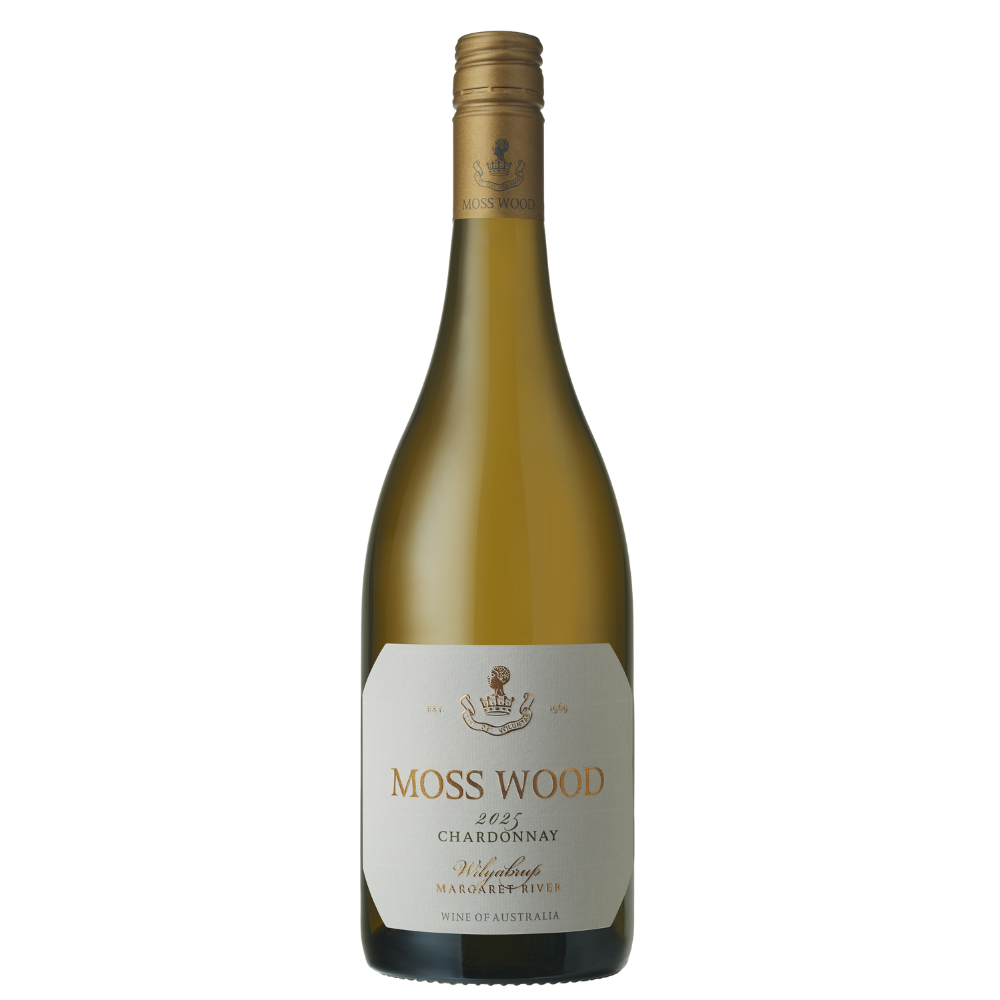
| Wine Facts | |
|---|---|
| Median Harvest Date | 3rd March, 2025 |
| Mean Harvest Ripeness | 13.2°Be |
| Yield | 5.03 t/ha |
| Growing Season Ave Temperature | 20.53⁰C |
| Number of hours accrued between 18 and 28⁰C | 1099 hours |
| Number of hours above 33⁰C | 54 hours |
| Days Elapsed between Flowering and Harvest | 117 days |
| Bottled | 5th August 2026 |
| Alcohol | 14.0 % |
Moss Wood 2025 Chardonnay – Fergal Gleeson, Great Wine Blog
Moss Wood have some of the oldest plantings of Chardonnay in Margaret River (along with Leeuwin Estate). The Moss Wood Chardonnay 2025 follows the classic house style of rich Chardonnays. It’s full bodied and concentrated with peach, nectarine, lime and cashew flavours. While many Australian winemakers are tilting to…
Moss Wood 2025 Chardonnay – Ray Jordan, Ray Jordan Wine
A most elegant and, at the same time, powerful chardonnay from a vintage which produced – well – elegance and power. Aromas of savoury lemon nuances with subtle butterscotch and marzipan character. The palate is texturally pleasing, with a deep and concentrated core that drives with urgency through to a…
Moss Wood 2025 Chardonnay – Mike Bennie, The Wine Front
A very convincing, fuller flavoured and yet controlled chardonnay of rich qualities and yet refreshing undertow. Quite a bit of nougat, vanilla wafer on red apple, nectarine, ginger biscuit and a sense of alpine herbs. It’s a big swish of flavour and texture, palate staining in a sense. Balanced and…
Moss Wood 2025 Chardonnay – Gary Walsh, The Wine Front
“Our first Chardonnay was made in 1980 and, after the difficult seasons of 1981 and 1982, it has been produced every year since 1983 from those original vines. The 2025 is our 44th overall release and 43rd consecutive vintage, continuing a story that will soon span half a century.” This…
Vintage Notes
After the early and dry 2024 season, 2025 saw a return to a more typical growing cycle. In many respects, the season reminded us of 2010, when consistent warmth, good water availability and an absence of prolonged extreme heat allowed Chardonnay to progress steadily through ripening and reach maturity around the beginning of March.
Rainfall provided an excellent foundation for the season. Calendar year 2024 delivered 1,176mm, around 16% above the long-term average of 1,018mm, ensuring our dry-grown Chardonnay vines entered the growing season with good reserves of soil moisture. A further 52.4mm fell between flowering and harvest, a marked contrast to the exceptionally dry finish of the previous season. For these old, unirrigated vines, the availability of water meant they were able to progress through summer without undue stress.
Flowering conditions were somewhat mixed. Rainfall was favourable, with 34mm recorded during this crucial period. Temperatures were slightly less accommodating, with 13 days below 8°C and the lowest temperature of 3.9°C recorded on 7th November. Interestingly, these conditions were remarkably similar to 2022, when we recorded 43mm of rain, 12 days below 8°C and a minimum of 3.8°C during flowering. In that season, the cold conditions appeared to have some impact on fruit set and bunch weights, and we suspect something similar occurred in 2025.
Once flowering was complete, conditions settled into a warm and generally favourable pattern. The average temperature for Chardonnay was 20.53°C, slightly above the long-term average of 19.7°C. The vines accumulated 1,099 hours between 18–28°C, almost exactly in line with the long-term average of 1,092 hours and comfortably above the 1,000 hours we consider a desirable minimum. There were 54 hours above 33°C, only slightly above the long-term average of 47 hours. In other words, 2025 provided plenty of warmth for ripening without exposing the vines to excessive heat.
Chardonnay took 117 days from flowering to harvest, exactly matching the long-term average. The median harvest date was 3rd March, almost precisely the long-term median of 2nd March, and the fruit reached 13.2° Baume, virtually identical to the long-term average of 13.1° Baume.
There were similarities here with the 2010 vintage. That season also progressed steadily through a largely normal ripening cycle, with Chardonnay harvested on 1st March at 13.1° Baume. The 2025 season was somewhat warmer, but in both years the vines were able to reach full maturity at a measured pace rather than through accelerated sugar accumulation.
Yield finished at 5.03 tonnes per hectare. This is around 24% below the long-term average of 6.6 t/ha, although only modestly below the levels we have seen over the past decade as the vineyard has aged. We believe vine age remains the major reason for this gradual reduction in productivity, with the cold conditions during flowering likely contributing to the slightly reduced crop in 2025. Importantly, water stress does not appear to have been a significant factor.
Overall, 2025 was a warm but balanced season, with good water availability, limited extreme heat and a growing cycle that was remarkably close to the long-term norm. The combination allowed our old Chardonnay vines to ripen steadily, reaching full flavour at moderate sugar levels and delivering a healthy crop in excellent condition.
Production Notes
All fruit was hand-picked and sorted before being whole-bunch pressed in our pneumatic press. The juice was clarified using flotation and then seeded with multiple yeast strains for primary fermentation.
Once fermentation was underway, the wine was transferred to 228-litre French oak barriques, of which 48% were new, where primary fermentation was completed. The wine then underwent full malolactic fermentation and remained in barrel for approximately 18 months.
At the end of the maturation period, the wine was racked and blended in stainless steel. Fining trials were carried out but none improved the wine, so it remained unfined. It was then cold stabilised and sterile filtered before being bottled on 5th August 2026.
TASTING NOTES
Colour and condition:
Medium straw hue with green tints; bright condition.
Nose:
The nose is immediately appealing, showing lifted aromas of white peach, nectarine and citrus, with hints of lime and grapefruit. Beneath the fruit are the typical Moss Wood Chardonnay complexities of cashew and roasted almond, together with nougat and lightly toasted notes from the barrel maturation.
Palate:
The palate is full-bodied and generous, with peach and nectarine fruit providing good weight and concentration. Fresh acidity runs the full length of the palate, bringing balance and giving the wine a lively, composed feel. Citrus and grapefruit notes provide freshness through the middle palate, while cashew, nougat and subtle toasty oak add complexity and texture. There is excellent depth without heaviness, and the combination of fruit weight and acidity gives the wine a long, clean finish.
Cellaring
As always, the challenge with Moss Wood Chardonnay is deciding whether to enjoy its youthful fruit and freshness or wait for the complexity that develops with bottle age. The 2025 has the fruit concentration, acidity and structure to make both options equally rewarding.
For those who prefer the wine in its youthful form, it can certainly be enjoyed now, when the peach, nectarine and citrus characters are at their most vibrant. Over the next decade, these primary fruit aromas will gradually give way to the secondary characters typical of mature Moss Wood Chardonnay, with increasing notes of toast, nuts, caramel and honey.
We expect significant bottle development from around 10 years of age, with full maturity at approximately 20 years old. Beyond that, well-cellared bottles should continue to develop for many years.